

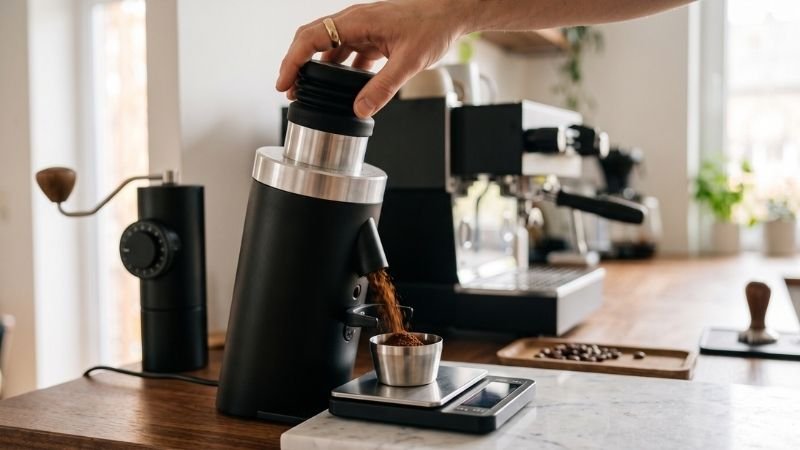
If you are looking for the best budget single dose coffee grinders under $300 for home espresso, you came to the right place. If you want easy push-button electric grinding for a real unpressurized basket, the Baratza Encore ESP is the clear king. If you want zero leftover grounds and super-tiny 16-micron clicks for a bottomless portafilter, the KINGrinder K6 easily wins the manual hand-grinder race.
If you have less than $100 in your pocket but still want thick golden crema, the Timemore Chestnut C3 ESP is your best friend. Then you have the Breville Smart Grinder Pro, a popular pick that you can upgrade with a cheap rubber bellows, and the OXO Brew, which works like a trusty mule for beginner pressurized baskets.
Before you upgrade your setup, please don’t burn your hard-earned cash on a crazy-expensive espresso machine. The real secret to great coffee hides right inside the grinder’s cutting burrs and how little stale dust it traps inside. I tested these top 5 budget options for you so you can easily pick the right grinder for your morning routine, your basket type, and your wallet—all while keeping your cash under that $300 limit. Let’s jump right in and check out these top 5 grinders together!
| Product Name | Grinder Type | Burr Set | Retention | Best For | Buying Option |
|---|---|---|---|---|---|
| Baratza Encore ESP | Electric (Conical) | 40mm M2 Steel | ~0.8g (Stock) / <0.2g (Tapped) | Overall Electric Pick | Check Price |
| KINGrinder K6 | Manual Hand Grinder | 48mm Heptagonal Steel | <0.05g (True Zero) | Dialing Precision & Clarity | Check Price |
| Timemore Chestnut C3 ESP | Manual Hand Grinder | 38mm S2C 660 Steel | <0.1g (Near Zero) | Value Pick Under $100 | Check Price |
| Breville Smart Grinder Pro | Electric (Digital Hybrid) | 40mm Conical Steel | 3.5g (Stock) / <0.2g (Modded) | High-Capacity Hybrid Setup | Check Price |
| OXO Brew Conical | Electric (Vertical Drop) | 40mm Conical Steel | 1.0g – 1.5g | Pressurized Starter Baskets | Check Price |
Quick Summary
ToggleWhat Defines a Capable Budget Espresso Grinder?
Single-dosing does not simply mean dumping 18 grams of beans into a hopper every morning. The real challenge is whether your grinder can actually spit those exact 18 grams right back out without keeping any old, stale powder for itself! In this section, we will look at the real-world features that separate an ordinary drip grinder from a true 9-bar espresso grinder.
Adopting a dedicated single-dosing workflow and bean cellars keeps your daily roast fresh without filling a massive hopper. As we discussed in our detailed guide about buying a grinder before an espresso machine, a cheap grind ruins everything. You can buy the most expensive machine in the world, but poor grinds will still serve you a sour or bitter shot every single day.
Dead-space retention and why stale grounds ruin extraction
The biggest flaw in low-quality grinders is internal dead space. They trap 2 to 4 grams of coffee powder between the motor housing, sweep paddles, and the chute. When you grind a fresh shot the next morning, that old, stale powder drops into your portafilter first, dropping your extraction pressure and carving nasty channels right through your coffee puck.
The true benchmark of a capable single-dose grinder is achieving “dead space / exchange retention (under 0.2g)”. Whether through a straight vertical drop chute or an aftermarket silicone bellows, minimizing this retention ensures that every single gram in your cup was freshly ground seconds ago.
The micro-step dialing problem: microns vs. marketing numbers
Many brands boast about having 40 or 60 grind settings on the box, but big numbers do not pull good espresso—microns per click do! To keep your water flow between 25 and 30 seconds in a commercial basket, you need tiny movements of 15 to 25 microns on every click.
If your grinder takes massive jumps of 60 to 100 microns, setting 5 completely chokes your machine, while setting 6 gushes out a watery shot in 12 seconds. That leaves you with a terrible cup of coffee and a ruined morning mood!
Top 5 Budget Single Dose Espresso Grinders Under $300 (In-Depth Reviews)
I tested all five grinders in this list, looking closely at daily workflow, trapped coffee powder, burr life, and real-world reliability. We will talk through the good and the bad of each one so you can pick the right tool for your hard-earned money.
1. Baratza Encore ESP - The Best Overall Electric Under $200
Baratza Encore ESP Conical Burr Grinder
40mm M2 Burrs & 20 Micro-Step Commercial 9-Bar Dialing
👉 Click Card to View Product Image & Check Live Pricing & 54/58mm Cup Specs on AmazonIf you want to save yourself from an unwanted morning arm workout on a hand crank the second your eyes open, you cannot beat the Baratza Encore ESP for push-button electric convenience under $200. The original Encore wore the crown for filter coffee, but pulling real espresso from it felt like total torture. With the ESP model, Baratza actually listened to the coffee community and redesigned the internal threads specifically for espresso. For plug-and-play ease, the ESP is widely regarded as the best low retention grinder for beginners.
| Specification | Technical Details |
|---|---|
| Burr Type & Size | 40mm M2 Conical Steel Burrs |
| Dialing System | Dual-Range (1–20 Espresso Micro-Steps / 21–40 Macro) |
| Dosing Interface | 54mm Anti-Static Cup + 58mm Adapter Ring Included |
| Measured Retention | ~0.8g (Stock Chute) / <0.2g (Lid-Tap Workflow) |
| Motor / Power | High-Torque DC Motor with Gear-Reduction Drive |
Dual-range micro-pitch adjustment
The biggest selling point of this grinder is its dual-zone collar system. Clicks 1 to 20 give you micro-steps for the process of dialing in espresso on commercial 9-bar baskets, while clicks 21 to 40 give you wide jumps for filter brews. But here is the real catch: if you run rock-hard, lightly roasted beans through it, your shot can still gush out too fast even on factory setting 1.
You fix this easily by sliding the included brass shims under the main shaft to calibrate tighter “burr alignment”, locking the burrs closer together so your coffee immediately tastes great. Also, single-dosing causes beans to bounce, which is why adding an anti-popcorn hopper mechanism or a weighted lid helps prevent uneven shards.
40mm M2 conical steel burrs
Inside, Baratza packed the same solid 40mm M2 conical steel burrs from their Virtuoso line. These pull a rich, syrupy body and thick crema out of medium and dark roasts. But keep this design quirk in mind: budget chutes lack an active “declumping screen / static reduction” flap, and the exit chute sits at a sharp 90-degree angle where a little spinning paddle pushes the coffee out.
Because of this, the grounds drop out in small, dense “cubes” instead of a fluffy spray. If you don’t break these cubes up with a needle WDT tool, water will blast right through the gaps and cause channeling. On the plus side, the strong motor and rock-solid Baratza warranty give you complete peace of mind.
Anti-static dosing cup
Instead of a messy plastic bin, Baratza gives you a dedicated 54mm dosing cup and a 58mm adapter ring. This cup flips straight upside down into commercial portafilters, keeping your kitchen counter clean. The paddle area can hold onto about 0.5g to 1.0g of fine grounds. To clear this out, just tap the hopper lid twice with your palm while the motor runs in its final two seconds.
That knocks those trapped grounds straight into the cup and brings your retention close to zero. If you own a Bambino or Barista Touch, the ESP’s 54mm dosing cup makes it one of the best espresso grinders for Breville machines.
PROS
- Steps 1 to 20 give genuine tiny adjustments for non-pressurized commercial baskets.
- The included 54mm/58mm dosing cup fits standard Breville and commercial portafilters directly.
- You can fix every single part at home with Baratza’s legendary customer service.
- The strong motor comes with a full Baratza warranty for total peace of mind.
CONS
- Grounds drop out compressed into clumps, so you need a needle tool to break them up.
- You need to tap the lid by hand to clear out all the trapped grounds.
Best For: this grinder is perfect for daily espresso drinkers and beginners who want a tough, easy-to-fix, dependable electric single-dose grinder without having to do sweaty manual labor before breakfast.
2. KINGrinder K6 - The Manual Precision Dialing King Under $120
KINGrinder K6 Manual Coffee Grinder
48mm Heptagonal Burrs & 16-Micron Exterior Dial Ring
👉 Click Card to View Product Image & Verify Zero-Retention Specs & Live Deals on AmazonIf you want crystal-clear flavor in your cup and clean shots on a bottomless portafilter, the KINGrinder K6 embarrasses expensive $500 electric grinders for just around $100 to $120. The moment you pick it up, its all-metal, solid aluminum body construction feels like a piece of high-end professional machinery.
| Specification | Technical Details |
|---|---|
| Burr Set & Material | 48mm Heptagonal (7-Sided) Stainless Steel |
| Adjustment Mechanism | Exterior Adjustment Ring (60 Clicks per Rotation) |
| Resolution Per Click | 16 Microns (0.016mm Pitch) |
| Chamber Capacity | 30g – 35g Whole Coffee Beans |
| Drill Compatibility | Standard Hex Shaft (Cordless Power Drill Compatible) |
Exterior 16-micron adjustment ring
The standout feature on the K6 is the adjustment ring right on the outside. You do not have to unscrew the grinder to count hidden clicks; you simply turn the outer ring to get 16 microns of surgical adjustment per click, dialing in your shot time by 2 to 3 seconds.
While commercial cafés rely on stepless micrometric grind adjustment, the K6’s 16-micron clicks come remarkably close for a fraction of the price. But because all that adjustment metal sits at the top, the grinder feels top-heavy. Keep a close eye on it on your counter, because a clumsy morning elbow can easily knock it over!
48mm heptagonal burrs
KINGrinder packed massive 48mm 7-sided stainless steel burrs inside, which grab beans way faster than tiny 38mm entry-level burrs. These big burrs grind an 18g double shot in a record 35 to 45 seconds. They deliver high consistency, bringing out the bright floral and citrus notes in your single-origin beans.
Just remember that super-dense light roasts will demand serious wrist and forearm strength. If your arm gives up, you can simply attach a cordless power drill to the top shaft and turn it into an electric grinder!
Zero-retention direct drop
Because your beans drop straight through the burrs into the metal cup below, retention sits practically at zero (<0.05g). Whatever weight you drop in, you get right back out fresh. The only small quirk is the handle connection, which slips onto a hex shaft without locking down.
If you crank aggressively at a weird angle, the handle can slide up a bit. Overall, this is one of the best budget single-dose grinders you can buy, and you can easily toss it into a bag for outdoor trips.
PROS
- The external 16-micron click dial gives you incredible control over your shots.
- It delivers true zero retention (<0.05g) without trapping stale coffee dust.
- The large 48mm burrs finish an 18g grind in under 45 seconds.
- The shaft works with a cordless power drill for effortless electric grinding.
CONS
- Hard light roast beans demand serious arm muscle to crank through.
- The slip-fit handle can feel loose if you crank too wildly.
Best For: espresso hobbyists and bottomless portafilter fans who want high clarity from single-origin beans and need café-grade dialing accuracy around $100 to $120.
3. TIMEMORE Chestnut C3 ESP - The Best Value Pick Under $100
TIMEMORE Chestnut C3 ESP Hand Grinder
S2C 660 Conical Steel Burrs & 23-Micron Micro-Step Plate
👉 Click Card to View Product Image & Check Color Options & Current Stock on AmazonIf your budget is strictly under $100 and you don’t want to waste money on cheap electric grinders with plastic burrs, the Timemore C3 ESP is your safest bet for aluminum body construction with manual grinding. Its textured aluminum body takes up almost no room in a kitchen drawer or travel bag.
| Specification | Technical Details |
|---|---|
| Burr Set Architecture | 38mm S2C 660 (Spike to Cut) Stainless Steel |
| Adjustment System | Internal Metal Plate (30 Clicks per Rotation) |
| Resolution Per Click | 23.3 Microns (0.0233mm Pitch) |
| Bean Capacity | ~20g – 25g Max Single-Dose Chamber |
| Grind Duration (18g) | 60 – 75 Seconds (Espresso Fineness) |
Spike-to-cut (S2C 660) burrs
Timemore installed 38mm patented Spike-to-Cut burrs here. Instead of crushing beans right away, sharp spikes crack them open first before the lower blades slice them. These burrs create a few extra fine particles, which actually work as a blessing for dark roasts and milk drinks because they build a thick, syrupy body and rich crema. The slight trade-off is that they can mask the delicate fruit notes in light roasts.
Fine 0.0233mm internal micro-plate
The older standard C2 was pretty much useless for espresso because its clicks were way too wide. Timemore fixed this on the ESP model by adding an upgraded adjustment plate that moves just 23 microns (0.0233mm) per click so you don’t choke your unpressurized basket.
However, Timemore hid this dial inside the bottom cup. To change your setting, you have to unscrew the cup, turn the wheel back to zero, and count the clicks one by one with your fingers.
Compact travel profile
The sleek aluminum unibody pairs perfectly with portable espresso makers like the Flair or Picopresso. But that compact size creates one limit: the bean chamber only holds about 20g of beans (so you must load it twice for a triple basket), and the small 38mm burrs take 60 to 70 seconds of non-stop cranking to finish an 18g dose. Even so, this grinder gives you fantastic zero-retention coffee for under $100.
PROS
- Solid CNC aluminum build and stainless steel burrs for under $100.
- Produces dense, syrupy crema that tastes incredible in lattes, flat whites, and dark roasts.
- Its compact size makes it perfect for traveling.
- It comes in stylish black and white finishes that look great anywhere.
CONS
- Takes 60 to 75 seconds of hand-cranking for an 18g double shot.
- It holds only about 20g of beans per single dose.
- The hidden internal click dial requires unscrewing the base to reset the count to zero.
Best For: budget-conscious home baristas who love medium to dark roasts, drink milk-based drinks, and want an ultra-compact zero-retention manual setup.
4. Breville Smart Grinder Pro - The High-Capacity Hybrid
Breville Smart Grinder Pro (BCG820BSS)
60 Settings, Digital Timer & Single-Dose Bellows Mod Ready
👉 Click Card to View Product Image & Check Brushed Steel Finish Pricing on AmazonIf you want an appliance that looks slick on your counter with brushed stainless steel and a digital display, the Breville Smart Grinder Pro makes a great choice. While it arrives out of the box as a standard large-hopper machine, the coffee community discovered a proven way to turn it into an awesome single-dose setup.
| Specification | Technical Details |
|---|---|
| Grind Adjustments | 60 Digital Macro Settings + 10 Internal Upper Burr Steps |
| Burr Set Architecture | 40mm Stainless Steel Conical Burrs |
| Display & Timer | Backlit LCD Screen (0.2-Second Dosing Increments) |
| Exchange Retention | 3.5g (Stock Hopper) / <0.2g (With Silicone Bellows Mod) |
| Included Accessories | 50–54mm Cradle, 58mm Cradle, Grounds Bin |
Digital LCD & timed dosing
The backlit front LCD screen gives you clear digital timing (in 0.2-second steps) along with 60 macro grind settings. The included magnetic cradles hold 54mm and 58mm portafilters completely hands-free.
However, those 60 steps can feel a bit wide for unpressurized commercial baskets. Moving between step 12 and 13 can swing your shot time by 4 seconds, so you often have to tweak your dose by 0.5g to balance the flow.
Adjustable internal upper burr
To stretch the grind range even further, Breville added an internal wire-handle adjustment directly on the top burr. You can manually adjust it from 6 down to 1 to grind ultra-fine. Keep in mind that the rotating paddle under the burrs is plastic and can wear out after 2 to 3 years of heavy grinding. Clean this area regularly so it lasts.
Large 450g hopper
The stock 450g hopper works great for grinding big batches, but it traps 3g to 4g of grounds inside the chute when single-dosing. The culprit is a mix of mechanical dead space and high static cling in the impeller cavity.
Published research on electrostatic charging during coffee grinding shows that managing surface moisture neutralizes static, preventing fines from sticking to internal parts. A single drop of water on your beans (RDT) makes an immediate difference.
You can solve the rest easily: grab a $15 silicone bellows kit from Amazon and pop it on top. When the motor runs, pump the bellows to blow out trapped grounds and drop your retention below 0.2g.
PROS
- Highly popular among coffee lovers thanks to thousands of great reviews.
- It includes hands-free magnetic cradles for both 54mm and 58mm portafilters.
- Turns into a genuine low-retention single-doser with an easy $15 bellows upgrade.
- It lets you set and program grind times in exact 0.2-second increments on the screen.
CONS
- It traps 3g to 4g of grounds right out of the box (so you really want that bellows mod).
- This grinder uses internal plastic parts that need routine cleaning to prevent long-term wear.
Best For: busy homes where family members want the ease of a regular hopper, while you can toss on the bellows mod to pull low-retention single-dose espresso shots.
5. OXO Brew Conical Burr - Best for Pressurized Baskets Under $100
OXO Brew Conical Burr Coffee Grinder
Direct Vertical Chute & 1-Touch Timer for Starter Baskets
👉 Click Card to View Product Image & Read 23,000+ Customer Reviews on AmazonWith over 23,000 reviews on Amazon, the OXO Brew is a massive crowd favorite. If you are moving away from stale pre-ground grocery bags and stepping into fresh whole beans, its clean stainless steel accents and simple one-touch dial make your morning routine effortless.
| Specification | Technical Details |
|---|---|
| Burr Set & Material | 40mm Conical Stainless Steel Burrs |
| Adjustment Range | 15 Macro Settings with Intermediate Micro-Notches |
| Chute Architecture | Direct Vertical Drop (Burrs Directly Above Cup) |
| Measured Retention | 1.0g – 1.5g (Direct Fall Design) |
| Timer & Controls | One-Touch Start Button with Integrated Memory Dial |
Straight vertical chute
The best feature on this grinder is the straight drop chute. The burrs sit directly over the grounds container, which keeps trapped coffee between 1.0g and 1.5g—something you almost never see in cheap electric grinders. Just know its limits: this machine is not built for bottomless unpressurized portafilters. Its 15 settings are quite wide, so you should use it strictly with pressurized dual-wall baskets (like the ones on basic De’Longhi machines).
40mm steel conical burrs
Solid 40mm steel burrs run on a slow gear-reduction motor. Operating at a lower “RPM speed” is crucial here because it prevents friction heat from cooking the delicate aromatic oils in medium and dark roasts. But if you feed it dense, rock-hard light roast beans, the lower-wattage motor will groan and slow down. Stick to medium and dark roasts to get the best performance out of this machine.
One-touch timer
You don’t have to deal with complicated menus here; the dial remembers your last run time, and one tap of the button finishes the grind cycle. In dry weather, the plastic grounds bin can collect static and make coffee fly around. Just add a single tiny droplet of water (RDT) to your beans before grinding to eliminate the mess completely. For the price, this grinder delivers great everyday results.
PROS
- Over 23,000 verified Amazon ratings show massive reliability and user trust.
- The straight vertical drop leaves very few grounds trapped inside.
- The simple, durable one-touch dial has zero learning curve.
- Clear 15-setting dial with mid-step micro-notches for drip, pour-over, and French press.
CONS
- Struggles and strains when grinding ultra-dense, lightly roasted beans.
- Cannot dial in non-pressurized commercial baskets (strictly for dual-wall pressurized portafilters).
Best For: beginners on a tight $100 budget who use dual-wall pressurized baskets and want a simple electric grinder that easily switches between espresso, drip coffee, and Moka pots.
How to Choose the Best Budget Single-Dose Espresso Grinder Under $300
When you shop for the best budget single-dose coffee grinders under $300 for espresso, you don’t need to drown in a massive list of features. You really just need to ask yourself one thing: do you want quick push-button speed, or do you mind putting in a little muscle before your morning cup?
Conical vs flat burr single dose grinder budget
When shopping in the sub-$300 bracket, you will almost exclusively encounter conical burrs. While expensive commercial grinders feature massive “40mm conical vs 64mm flat burrs” to chase ultra-high flavor clarity, smaller conical burrs are far more forgiving for home baristas.
They produce a bimodal grind profile (a balance of fine and medium particles) that creates a dense, syrupy body and long-lasting crema, making them ideal for morning milk drinks like lattes and cappuccinos.
While newer budget flat-burr options like the DF54 exist around $230, conical burr workhorses like the Encore ESP and manual precision tools like the K6 remain the most reliable, easy-to-dial options under $300 without complex burr alignment issues.
Burr quality & grind consistency
A budget espresso grinder lives or dies by how evenly it cuts your coffee beans. Getting fine grounds is only half the job; real testing on particle size distributions across espresso grinders shows that too much fine coffee dust can easily choke your machine and ruin shot flow. Well-made burrs keep the grounds uniform from edge to edge. That means fewer weak spots in the coffee bed and smooth, sweet shots every morning instead of sour gushers.
Electric convenience vs. manual dialing resolution
If you take the manual route (like the KINGrinder K6), 100% of your money goes straight into sharp CNC-machined steel burrs and smooth micro-bearings. Because of that, a $100 to $120 hand grinder gives you the same 16-micron particle consistency you normally see in a $400 Eureka Mignon!
On the flip side, a $200 electric grinder (like the Baratza ESP) spends a big chunk of its manufacturing budget on motors, wires, and outer plastic shells, leaving you with 20 micro-steps to dial in. Your real choice is simple: can you handle a 40-second morning arm workout for cleaner, better-tasting shots? That choice is totally yours.
Essential workflow tools: why RDT and WDT are mandatory
Budget grinders rely on plastic and cast-metal bodies that tend to build up annoying static electricity. Since you are single-dosing without a massive hopper of beans pushing coffee through, you need two simple tricks to keep your workflow clean:
- Ross Droplet Technique (RDT): Adding a single tiny drop of water to your whole beans before grinding—eliminates static flyaway grounds instantly and cuts chute retention by over 70%.
- WDT (Weiss Distribution Technique): Grab a cheap tool with 0.3mm to 0.4mm needles and stir your grounds right in the portafilter basket. This easily breaks apart those dense little coffee clumps from the Baratza ESP or Breville, so water doesn’t punch holes through your puck.
Frequently Asked Questions
Every beginner runs into a few common questions when building a budget single-dose coffee bar. Here are the exact, no-fluff answers gathered from real-world testing and community forum discussions:
Can a grinder under $100 pull true 9-bar unpressurized espresso?
Yes, but only if you buy a precision manual hand grinder, such as the Timemore C3 ESP or the KINGrinder K6. Electric grinders under $100 simply do not have micro-adjusting collars or properly aligned steel burrs, so they only work with pressurized dual-wall baskets.
What is the main difference between the original Baratza Encore and the Encore ESP?
The standard Encore uses 40-wide macro-steps designed strictly for filter and drip coffee, which either completely choke espresso baskets or let water gush right through. The newer Encore ESP packs upgraded commercial M2 burrs and a smart dual-range collar where steps 1 through 20 give you tiny micro-steps specifically for espresso, making it way better than the old classic model.
Does using a silicone bellows damage the grinder motor?
No, bellows will not hurt your motor as long as you pump them while the motor is running and the burrs are spinning. If you pump air into a turned-off grinder, you can push fine coffee dust backwards into the motor seals and bearings.
Why does my espresso shot run too fast even on the finest setting?
If your shot flows way too fast on setting 1, your burrs have too much factory space between them. You can fix the Baratza ESP by slipping the included brass shims under the center shaft to lock the burrs closer together. On the Breville Smart Grinder Pro, pop off the hopper, grab the wire handle on the top burr, and click it down from setting 6 to setting 1.
The Final Verdict: Which Budget Single-Doser Should You Buy?
When you boil down all these technical details into a simple buying choice for single dose espresso grinders under $300, your answer becomes super clear. If you want push-button 9-bar espresso shots and easy milk drinks without any morning arm workout, the Baratza Encore ESP is the undisputed electric winner. If you own a Bambino or Barista Touch, the ESP is one of the best espresso grinders for Breville machines.
If you want bright, floral flavor clarity from a bottomless portafilter and don’t mind 40 seconds of hand-cranking, the KINGrinder K6 easily beats $400 electric grinders for taste in the cup. If you have a strict $100 budget and want thick, classic crema, grab the Timemore Chestnut C3 ESP. For a hybrid setup with a bellows mod, pick the Breville Smart Grinder Pro, and for simple pressurized baskets, the OXO Brew is your safest budget electric bet.
I hope this guide helps you pick the best budget single dose coffee grinders under $300 for home espresso! If you are building your home espresso bar from scratch and don’t know where to begin, definitely read our complete guide on putting together a home espresso bar to save yourself headaches. If you have any questions left, drop a comment below or send us an email—we’re always happy to help!