

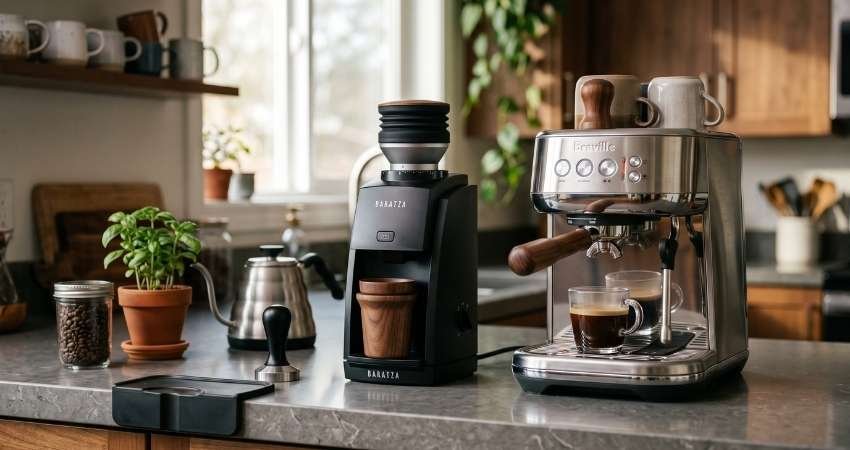
If you are setting up your home coffee bar and wondering whether to buy an espresso machine or grinder first, here is the honest and direct answer: always invest in the grinder first, or at least buy it together with the machine. You might not know this, but the grinder’s burrs decide about 80% of your coffee’s taste and quality. Your expensive machine is basically just a glorified kettle pushing hot water through under pressure.
Keep one thing in mind: even if you buy a $2,000 luxury espresso machine, pairing it with a cheap spice grinder means your coffee will always end up sour, watery, and bitter. Making the grinder your top espresso machine vs grinder budget priority ensures your shots taste delicious right from the start. Let’s break down why the grinder is more important than espresso machine hardware.
Quick Summary
ToggleThe Coffee Science: Why the Grinder is More Important than Espresso Machine Hardware
You may think ‘a grinder makes uniform powder,’ but when hot water hits the coffee under high pressure, it needs an even, smooth layer of coffee to pass through. When 9 bars of water pressure hit your coffee puck, the water demands equal resistance across every single millimeter. If you wonder “can you make good espresso with pre ground coffee or cheap grinders,” the particle size distribution holds the answer.
When you use a blade grinder or a cheap burr mill, they do not slice beans evenly. Instead, they smash the beans into a messy battle of fines vs boulders:
- Boulders (Big Chunks): Water rushes right past these large pieces with zero resistance. This only dissolves the harsh surface acids while leaving the sweet oils behind, making your cup taste sharp, sour, and salty. Definitely not an enjoyable cup.
- Fines (Microscopic Dust): This ultra-fine powder clogs the small holes in your filter basket. It over-extracts and dumps a burnt, charcoal-like bitterness straight into your coffee.
A dedicated espresso grinder produces a controlled bimodal vs unimodal grind profile that guarantees espresso extraction consistency. This precise particle spread forces water through the coffee bed slowly and evenly, extracting natural sweetness, complex aromas, and that gorgeous golden crema you actually paid for. Under guidelines from the Specialty Coffee Association (SCA), creating the water resistance needed to extract rich espresso oils depends entirely on the precision and uniformity of the coffee grounds. That is how you get true barista-style coffee at home.
The Pre-Ground Trap: Can You Make Good Espresso with Pre Ground Coffee?
A lot of beginners make the mistake of thinking: “Let me buy the machine first, and I will just get fresh beans ground at my local roaster or cafe.” But this trick fails within your very first week due to serious stale pre-ground coffee limitations:
Trapped CO2 gas vanishes in 15 minutes
Fresh roasted coffee beans trap carbon dioxide inside their structure, which slowly escapes after roasting. When you grind the beans, you increase their surface area thousands of times, and within 15 to 30 minutes, all that CO2 escapes into thin air. Without that trapped gas, the machine’s 9-bar pressure cannot blend the water and natural coffee oils together. The result? Zero crema and sad, flat coffee.
Daily weather and room humidity
Coffee powder acts like a sponge for room moisture. If it rains in the morning or room humidity goes up by just 10%, the coffee particles swell up. Baristas adjust for this daily by dialing-in puck resistance (called dialing in). With a pre-ground bag, you have zero control over adjustments. The bag that worked in the morning becomes completely unusable by the afternoon, wasting your expensive beans. Roasted coffee beans are hygroscopic, meaning they constantly absorb moisture from the air, shifting your ideal grind setting from one morning to the next.
The pressurized basket trick
Most machine makers put pressurized baskets in the box just to keep beginners happy. When looking at pressurized vs non-pressurized portafilter baskets, pressurized baskets do not create crema from coffee resistance; they force liquid through a single tiny pinhole at the bottom to whip up fake, airy foam. This foam is airy and is definitely not real espresso crema. For real specialty coffee, you need a non-pressurized basket, which demands an accurate, fresh grind. Without that, an expensive machine on your counter is pretty much useless.
How Inconsistent Particle Size Causes Severe Channeling and Water Bypass
When you use a low-end grinder, the coffee bed ends up with uneven density, which ruins your entire shot. You get clumps of microscopic dust in one spot and loose gaps between big chunks in another. When the pump drops 130 PSI (9 bars) of water pressure onto that coffee puck, the water naturally hunts for the path of least resistance, causing channeling and water bypass:
- Water blasts through those cracks and weak spots, carving out tiny high-speed tunnels.
- The spots where water rushes through over-extract and dump a burnt taste into your cup, while the rest of the dry coffee puck barely gets wet and leaves behind a sour mess. You end up with a cup that tastes burnt and sour at the same time.
- If you want to see this happen in real time and you use a bottomless (naked) portafilter, you will notice coffee spraying violently all over your machine and kitchen counter instead of flowing into a nice, smooth stream in the center.
When your grind has both large boulders and fine dust, water rushes through weak points in the puck. As studies on espresso extraction flow show, this channeling pulls bitter and sour flavors at the exact same time. A dedicated grinder with precise burr alignment stops channeling at the root because it creates tightly locking particles across the whole bed, giving you that smooth, barista-style pour.
The 50/50 Budget Rule: How Much to Spend on Espresso Grinder vs Machine
If you have a total budget of $1,000, the classic beginner mistake is spending $800 on a shiny machine and scrambling to find a cheap $200 grinder with whatever cash remains. You need to play it smart here. Real-world barista experience proves this exact formula:
| Setup Type | Machine Budget | Grinder Budget | Extraction & Crema Quality |
|---|---|---|---|
| Wrong Beginner Setup | $800 (High-End Machine) | $200 (Entry Burr/Blade) | 🔴 Bitter, watery, high channeling, thin foam |
| Optimal Expert Setup | $500 (Entry Single Boiler) | $500 (Single-Dose Precision Grinder) | 🟢 Thick syrupy body, golden crema, sweet notes |
When planning your espresso machine vs grinder budget, aim for an even 50/50 split, so your grinder matches the capabilities of your machine. If your budget is super tight at the start, buy a high-grade grinder for $300 to $400 first. If you need a solid grinder for your home espresso bar setup, you can check out our Best Budget Single Dose Coffee Grinders Under $300 guide. In that post, I reviewed the top 5 budget grinders on the market so you don’t have to waste your cash guessing which one actually pulls great shots!
While you save up for that new espresso machine, this grinder will boost the flavor of your daily French Press, AeroPress, Moka Pot, and pour-over coffee by ten times. When you finally pick up a basic espresso machine in a month or two, your daily workflow will run smoothly from day one, and you will actually enjoy great coffee.
Espresso Grinder Buying Guide: 3 Must-Have Features Before You Buy
When you pick your first grinder, ignore the shiny marketing buzzwords and focus on these three mechanical standards instead:
Stepless micrometric adjustment
Standard consumer grinders use “stepped” click settings (1, 2, 3). For real espresso, step 2 might flow way too fast (water rushes through in 12 seconds), while step 1 completely chokes the machine. A stepless dial gives you the freedom to make smooth micro-adjustments and grind steps so you can balance your extraction time second by second.
Zero dead-space retention
Most older hopper grinders trap 3 to 5 grams of old coffee powder inside the chamber and chute. When you grind your morning shot, yesterday’s stale grounds fall out first and ruin your flavor. Look for near-zero burr retention/exchange (under 0.2 grams) using single-dose grinders with rubber bellows.
Burr geometry (conical vs. flat)
Conical burrs work best for traditional Italian-style dark roasts, giving you heavy body and an easy, forgiving workflow. Flat burrs shine when you want flavor clarity, ultra-uniform particles, and the sweet floral notes of modern light roasts.
Frequently Asked Questions (FAQs)
Is it better to get an espresso machine with a built-in grinder?
Machines with built-in grinders (like the Breville Barista Express) work great at first and save plenty of counter space. However, for the long run, a standalone dedicated grinder always wins. Built-in grinders offer fewer micro-adjustment steps; the heat from the boiler warms up your beans, and if the grinder breaks or you want an upgrade later, you must replace the entire machine—which gets super expensive. A separate grinder gives you much better consistency, total freedom to upgrade anytime, and brews way better coffee.
What is the 30-second rule for espresso?
The 30-second rule is a classic standard for espresso brewing. Here is the simple science: when you put 18 grams of ground coffee into your basket, pulling a 36-gram shot of liquid espresso should take between 25 and 30 seconds. If your shot rushes out in under 20 seconds, your grind is too coarse, leaving you with sour coffee. If it takes longer than 35 seconds, your grind is too fine, dumping bitter, burnt flavors into your cup. This simple rule helps you dial in your grinder size perfectly every single time.
Can I grind regular coffee beans for espresso?
Yes, absolutely! “Espresso” is not a special type of coffee bean; it is just a brewing method. You can use any high-quality regular whole beans you like. The real challenge comes down to the grinder: regular drip or filter coffee grinders cannot crush beans fine and evenly enough for a 9-bar pressure machine, ruining your coffee’s flavor. So, grab whatever beans you love, but always run them through a dedicated espresso grinder.
Can a manual hand grinder work for espresso on a budget?
Yes! If your budget is tight, a solid manual hand grinder (with steel burrs and fine adjustment clicks) is your best friend. Compared to electric models, a good hand grinder delivers commercial-grade consistency for less than half the price. The only catch is putting in 30 to 45 seconds of elbow grease for every shot you pull. But for flavor and grind quality on a budget, it makes a fantastic choice if you don’t mind a quick morning arm workout.
The Final Verdict: Should You Buy an Espresso Machine or Grinder First?
An espresso machine really just delivers hot water at a set temperature and pump pressure. Creating resistance against that water, controlling the extraction speed, and unlocking those delicate coffee oils is 100% the grinder’s job. Many people make this exact mistake, pair a cheap grinder with their setup, and ruin their home coffee bar experience.
If you are still wondering which piece of gear deserves your money first: always buy the grinder first. A basic $400-$500 machine paired with a $400-$500 precision grinder can pull world-class espresso shots. Also, if you want to learn how to build a proper setup, read our guide: “How to Put Together the Perfect Home Espresso Bar” and start brewing cafe-quality cups right at home.
If you think an expensive machine solves everything, remember that a $1,000 to $2,000 commercial machine with a cheap grinder will only give you a headache and terrible-tasting coffee. Start with the grinder. It will save you money, stop bad coffee, and give you great espresso every day. Have a fantastic day, and enjoy brewing amazing coffee!